Financing Your Timber Frame Home: Loans, Budgets, and Payment Options
Updated: March 26, 2026
Most timber frame buyers spend months perfecting their design and almost no time planning their financing.
Then, they sit across from a lender who has never heard of a bent, doesn't understand why the frame costs more than the foundation, and can't fit the project into their standard loan software.
The result is confusion, delays, and sometimes a stalled project before construction even begins.
Here's what you actually need to know to get a timber frame home funded and built.
Understanding Construction Loans
Construction loans fund the building process, not a finished home. Money is released in stages as work is completed, interest accrues only on the amount drawn so far, and the loan typically converts to a permanent mortgage once construction wraps up.
Expect to put down 20–25% rather than the 10–15% required for conventional mortgages, since lenders view custom builds as higher risk.
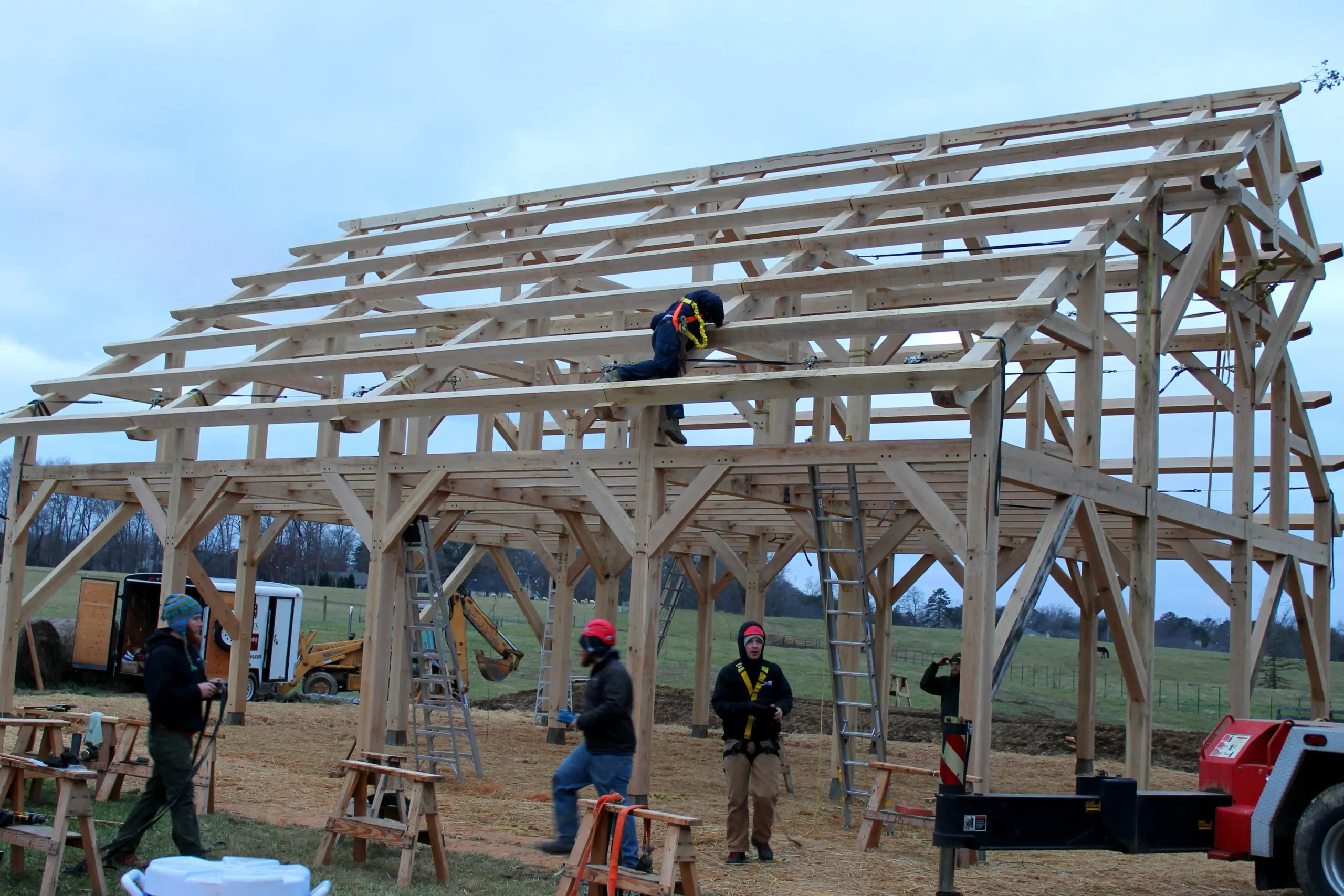
For timber frame projects specifically, your draw schedule needs to account for the fact that the timber package often represents 20–30% of your total budget and is ordered and paid for early in the process.
Many lenders have never financed a timber frame build, so you may need to walk them through your construction timeline and bring documentation from your timber frame company explaining the process.
If your first lender says no, find a regional bank or credit union with custom build experience rather than wasting months with a national lender who processes only tract home mortgages.
The Real Cost Breakdown
The timber frame package is not your biggest expense. The frame typically represents only 20–30% of your total project budget, with foundation, enclosure, interior finishes, and mechanical systems making up the other 70–80%.
Here's how timber frame home costs generally break down:
- Foundation and site work (10–15%): Expect $30,000 to $50,000 for a straightforward lot, potentially over $100,000 for sloped or remote sites.
- Timber frame package (20–30%): A 2,000-square-foot frame runs $60,000 to $120,000. Complex designs with specialty timbers or intricate joinery can exceed $200,000.
- Enclosure system (15–20%): Walls, roof, windows, and doors. Structural insulated panels cost more upfront than stick framing but provide significant long-term energy savings. Budget $40,000 to $80,000.
- Interior finishes (20–25%): Flooring, cabinetry, countertops, tile, and trim. Costs range from $30,000 on the modest end to $150,000 for custom everything.
- Mechanical systems (15–20%): HVAC, plumbing, and electrical systems, with creative routing required around exposed timber. Plan for $50,000 to $100,000.
A 2,000-square-foot timber frame home typically lands between $400,000 and $700,000, depending on finishes, location, and site conditions. Price per square foot generally runs $200 to $350 or higher. Anyone quoting $150 per square foot is leaving out major cost categories.
Finding the Right Lender
Regional banks, credit unions, and lenders who specialize in construction loans are your best starting points. They review projects individually rather than running them through automated underwriting designed for subdivision homes.
Your timber frame builder is also a valuable resource here since established manufacturers have watched hundreds of projects get financed and know which lenders in your region actually close deals on specialty builds.
When talking to a lender, ask directly: How many custom home construction loans have you funded in the past year? Have you financed a timber frame home before?
The answers tell you quickly whether they can help or whether you're about to spend months in documentation limbo with someone who will ultimately decline.
Building a Budget That Holds
The most common budgeting mistake is skipping the contingency fund. A 15–20% contingency is not optional on a custom build. Set aside $60,000 to $100,000 on a $500,000 project for unexpected costs.
Site conditions change, material prices shift, and subcontractors get replaced. If your budget is maxed before construction starts, you're gambling that nothing goes wrong during a 12–18 month build.
Once you set up a contingency fund, break your budget into detailed line items rather than broad categories. "Finishes: $80,000" tells you nothing when you need to make cuts.
Specific line items for flooring, cabinetry, countertops, lighting, and tile give you real decision-making information. It also helps to separate must-haves from upgrades so that if costs run high, you know exactly what to defer without compromising the core project.
Lock in fixed-price contracts for your timber frame package, foundation, and enclosure system as early as possible. These three categories represent 45–65% of your total cost, and price protection here is worth the effort to negotiate.
Managing Draw Schedules
Contractors expect payment when they finish work. Your lender releases funds after scheduling an inspection, which can take two weeks. This gap can create friction if you haven't planned for it.
Share your draw schedule with every contractor before signing contracts so their payment expectations match when money actually moves.
Negotiate milestone-based payments that align with your draws: for example, 30% of the timber package on delivery, 40% on frame raising, and 30% when the dried-in inspection passes.
Keep $20,000 to $40,000 in accessible cash to bridge timing gaps and prevent work stoppages while waiting for draw approvals.
Working With Your Timber Frame Company
Most timber frame manufacturers require a 30–50% deposit at contract signing, with the balance due on delivery or installation. This can create tension with your draw schedule if the payment falls due before your lender releases corresponding funds.
Choosing a timber frame company is not a decision to take lightly. Choose wisely, and have an honest conversation with the project manager about your financing situation before signing.
Many manufacturers who regularly work with financed projects will structure milestone-based payments that align with your draws. Those who refuse any flexibility may not be the right fit if you're working with limited cash reserves.
Carefully Planned Financing Makes the Build Possible
Many people forget that timber frame companies have seen every financing scenario imaginable. Take advantage of that resource.
Your timber frame manufacturer can point you toward lenders who have closed deals like yours, flag payment timing issues before they become problems, and help you present the project in terms a bank can underwrite.
The key to achieving the best financing outcome on a custom build is to treat the financing as seriously as any other part of the project. Find the right lender early, build a budget with real contingency, and coordinate payment timing before problems arise rather than after.
Ready to begin planning your dream timber frame home? Book your free consultation callwith Homestead Timber Frames, a company committed to structural excellence and enduring craftsmanship, today to discuss your project and explore custom design options.