Without prior knowledge, it is easy to assume that building a timber frame home is the same as any custom home. While there are some similarities, it’s really like comparing apples to oranges.
The extra craftsmanship, premium materials, and intricate production processes involved in timber frame homes make the construction process more complex. However, with the right timber frame company and builder, it can be done seamlessly. Understanding the cost to build a timber frame home, including the price per square foot, is crucial for planning and budgeting your dream project.

How Much Does A Timber Frame Home Cost To Build?
The costs of a timber frame home versus a conventional stick frame home can vary depending on how you want to finish out your home. The area of the country you’re building in may play a role in building costs as well.
To know exactly how much extra cost you’ll be incurring with a timber frame home, you’ll first need to know whether you desire a full timber frame or a hybrid. Many people who are interested in timber frame kits may not even realize the difference between the two, but it can make a noteworthy difference in the price of the home.

Full Timber Frame
A full timber frame home will require a foundation that can support the load where the posts are located in the house. This type of construction often involves more intricate craftsmanship and materials, contributing to higher construction costs.
Just remember there’s so much more today you can do with timber framing when building a custom home.
The cost of a timber frame, including the price per square foot, can vary significantly based on design preferences and the timber frame supplier you choose. The styles can reflect Modern, Craftsman, Traditional, European, or Mediterranean aesthetics. Interestingly, you might not need as much timber as you think to achieve the desired look for your dream home. With the versatility of timber framing, you can create a truly unique and custom floor plan.

Hybrid Timber Frame
A hybrid timber frame combines elements of both timber framing and conventional stick framing. Typically, a hybrid with conventional framing costs roughly 15% more than a traditional frame and may be 20% higher than a custom conventional stick frame house, depending on design factors. The total cost can be influenced by square footage, fixtures, window packages, and other finishes. These are critical considerations before starting the design process.
According to Timber Home Living, alternative enclosure and insulation options can come with a 4-6% higher upfront cost. However, these options can save you money in the long run through lower energy costs. Installation is quicker too, which can help keep the building project on schedule and reduce labor costs. An experienced timber framer can help you understand all of your finishing options and what is best for your specific desires and budget.
Factors That Can Affect The Cost of Building A Timber Frame Home
The design of your timber frame home plays a significant role in determining the overall cost. Many factors come into play when estimating the timber frame cost, including the complexity of the floor plan, the type of wood species used, and the extent of timber frame construction. For instance, a more intricate design with numerous custom features and unique architectural elements will generally cost more than a simpler, straightforward layout.

Complexity of the Floor Plan
The complexity of your home's floor plan is one of the primary factors affecting the cost. A more intricate design featuring custom features, unique architectural elements, and expansive open spaces will generally be more expensive than a straightforward, simple layout. Custom designs often require additional labor and materials, which can increase the timber frame cost significantly.
Wood Selection
The type of wood species you choose for your timber frame construction greatly influences the overall cost. Premium hardwoods, known for their durability and aesthetic appeal, tend to be more expensive than common softwoods. For example, using oak or walnut will raise the timber frame cost compared to using pine or spruce. It's essential to balance your desire for specific wood characteristics with your budget constraints.

Insulation
Proper insulation is key to ensuring your timber frame home is energy-efficient and comfortable. The method and materials you choose for insulation can vary in cost. High-quality insulation might have a higher upfront cost but can lead to significant savings on energy bills in the long run. Options like spray foam, structural insulated panels (SIPs), or traditional fiberglass each come with their own cost implications and benefits.
Location and Building Site
The location of your building site plays a significant role in the overall construction cost. Factors such as soil conditions, site accessibility, and regional building codes can impact the foundation and site preparation expenses. A well-chosen site with favorable conditions can save money, whereas a challenging site may require additional work and costs. Additionally, the cost of labor and materials can vary by region, further influencing your budget.

Custom Features and Finishes
Adding custom features and high-end finishes to your timber frame home can enhance its beauty and functionality but will also increase costs. Elements such as timber frame porches, heavy timber accents, and bespoke interior designs add visual interest and appeal but require additional investment. It's important to prioritize these features based on your budget and design preferences.
Our goal at Homestead Timber Frames is always to design within your building budget. We do believe that a bit of heavy timber on the exterior of your home will help balance what’s on the inside and give your home that ‘curb appeal’.
Building a timber frame home involves various factors that affect the total cost. Whether opting for a full timber frame or a hybrid, the construction costs, including those for the foundation, fixtures, and finishes, need to be carefully planned. Working with a knowledgeable builder and timber frame supplier will ensure that your building project is a success, resulting in a beautiful and efficient dream home.
One very special moment in every couple’s life is their wedding and our society is witnessing a rebirth of outdoor celebrations for this memorable event. A specially designed timber framed pavilion built exclusively for people who cater these outdoor weddings is our expertise. Our team visits the site and can serve as consultants as to the size needed and how it could fit into the existing landscaping and layout of the other buildings. Our favorite designs come from clients who want to blend their surroundings with the pavilion and create the impression that the intricately designed timber frame has been there for a long time. We try to match our structures to blend with the setting as well as other buildings it may connect to. They can be rustic, simple, ornate, hip roofed or gabled – the choices are many and Homestead Timber Frames is ready to help.

A few of our structures have needed to be large enough for up to 250 people to be seated at round tables for a reception while others want a smaller more intimate gazebo type structure just for the bride and groom to stand in. The requests vary of course from every size in between and choices in style. Our goal is to make each handcrafted pavilion we build to be unique to the setting and structured for the purpose it will serve. All our clients recognize that we offer high quality craftsmanship, personalized design services, and thoughtful ideas for them to consider when planning for outdoor wedding venues.

What is a tenon as it applies to timber framing? By definition, a tenon is a projection on the end of a timber used for joining multiple members together. Timber frames receive a multitude of handcrafted tenons and each tenon is created with great care and will end up joined inside a mortise.
A tenon starts life as a set of lines on the side of a timber post, beam, or knee brace. Each line is drafted using the timber frame shop documents as a guide for length, width, and placement. This is referred to as ‘laying out’. Every member of a timber frame is laid out and checked before it is fabricated.
The Tenon Fabrication Process
Once the tenon is laid out it is time to double-check the work, grab a saw, and start cutting. Our crew uses different sizes of circular saws to make the various cuts required in fabrication. Once the saw is set to the correct depth the cutting can begin.
Depending on the tenon length this is usually a series of four cuts. One cut on each side defining the position of the tenon and two additional cuts to remove the waste material. At this point, we have the basic shape of a tenon.

Precision and Accuracy in Joinery
The tenon is then evaluated for consistency and accuracy. Any imperfections are worked away with a chisel. Using a mallet and chisel, the joiner takes care to skim off waste material and leave behind a work of art that is ultimately hidden within its respective mortise.
Although never seen again, accurate tenon fabrication is crucial for a tight-fitting timber frame. The more accurately the tenon is cut is directly related to how well the members of the frame fit together. Too short and you end up with a sloppy joint, too long and the tenon sticks out of the mortise. Our shop crew creates tenons so accurately that they receive a bevel at the end for easier fitment.

Once a series of mortises and tenons are cut, it is on to pre-fitting the frame in sections. During the pre-fit of the timber frame, the peg holes are drilled through the assembled mortise and tenon joints so that once raised, this geometry translates to the assembled frame and is truly a hidden work of art.
The frame seemingly squeezes itself together along with the raising crew to perfect fitment but in reality, it is the skill of the joiner that creates this illusion.
For decades, airplane hangars crafted of stone and steel have been the norm. As more and more of you discover the amazing benefits of timber frame airplane hangars, the norm is changing!
There’s a lot to consider when you’re deciding to build a new structure on your property. Timber frame structures, including timber frame airplane hangars, include more specific considerations than most structures when you’re planning a build.
Here are 5 specific things you should consider when you’re choosing to build a timber frame hangar.
1. How Much Space Do You Need?
Timber frames naturally lend themselves to larger structures. In your mind, you may be thinking:
“The bigger the structure, the better it’ll be.”
Well, that isn’t always necessarily the case. Big structures are great, but they’re also:
- More time-consuming to design and build
- Needy of more maintenance and care
- Not budget-friendly
If you don’t have a massive plane to store, several small planes to store, or a fleet of cars, you won’t really need a huge timber frame hangar. Before you consider building a timber frame hangar, take a look at how much space you’ll actually need. You’ll end up saving yourself plenty of time and money!
2. Do You Want Your Hangar to Be a “Full” Timber Frame?
When you’re considering building a timber frame hangar, you have the option to stick with a full timber frame, or a hangar that simply incorporates timbers in specific areas. Whether or not to choose a full or partial timber frame hangar depends on a few things:
- Your budget
- Your aesthetic taste
- Your preferred style of joinery
Full timber frames tend to be more expensive, and the style isn’t for everyone. You may also think joining heavy timbers with metal will make it stronger than a conventional timber frame structure. However, for the expense, a timber frame hangar joined with timber elements will, in most cases, be stronger than a traditional steel hangar.
3. Who’s Designing Your Aircraft Hangar?
Designing and building timber frame structures takes a very specific set of skills. Designers and architects, for example, need to know how to combine the heavy timbers in a way that makes structural sense. Engineers and builders should be able to put them together in a way that ensures that the timber frame structure is strong and durable.
Before you opt to build a timber frame hangar, make sure you’ve joined (yes, pun intended) up with a team that can help you put it together from start to finish. By joining (again, pun intended) up with professional designers, architects, structural engineers, and joiners, you’re making sure your timber frame hangar will stand for generations to come.
4. What Kind of Timber Do You Want to Use?
Timber frame structures are always made with strong, durable heavy timbers. However, some timbers work better for some timber frame structures than they do for others. For example, while you can have an entire timber frame hangar built of, say, Baldcypress, it’s not ideal.
Your timber frame hangar will likely be an enclosed structure, which means you’ll want to use species that work best for interior areas. These timbers will need to span long distances for larger hangars so typically the use of Glulam's will be necessary to make those clear spans possible.
Here at Homestead Timber Frames, our wood species of choice for these large spans and types of structures is Douglas Fir. There are other species that can be used in the smaller hangars but we feel the Douglas Fir is the best all around for this application.
5. Your Budget
All of the above are very important to consider when you’re looking into building a timber frame hangar. However, none are as important as this one factor: your budget.
You may dream of a large, spacious timber frame hangar. However, the size and opulence of your heavy timber structure will depend on how much you’ve budgeted for your build. That’s why knowledgeable, experienced timber framers (like us) will work with you to help you reach as much of your dream timber frame structure as possible without breaking your budget.
Are you currently considering building a timber frame hangar?
Reach out today and call us at (931) 432-0132 or use our contact form. We’ll be happy to help you put together the timber frame hangar you’re looking for!
If you know us, you know we could go on forever about the benefits of building a timber frame airplane hangar. Like any timber frame structure, timber frame hangars are strong, versatile, and spacious!
Like any structure, though, timber frame hangars aren’t perfect for everyone. We mean, they’re pretty darn close, but it all depends on your preference. To find your preference, you’ll need to weigh some pros and cons.
“But Homestead,” you may ask, “what exactly are the pros and cons of building a timber frame hangar?” Well, let’s explore a few of them.
Pro: Timber Frame Hangars Require Little Maintenance
Metal airplane hangars take a lot to stay in functional shape. They take a lot of pressure washing, and the caustic cleaners you’ll need to use to keep them from corroding or rusting can:
- Wear down the integrity of your metal structure
- Damage whatever you’re storing in the hangar
- Ultimately be harmful to your health

Timber frame hangars require less attention and maintenance than a typical metal airplane hangar. There are natural finishes, like Heritage that you can apply to your timbers to keep them virtually maintenance free or you can leave them natural and they will age on their own not affecting their strength. Keep in mind if you paint or stain the timbers you will likely have to reapply years down the road, so essentially your maintenance is whatever you would like it to be.
Con: Certain Timber Species Are More Prone to Rot and Decay
For as much as we evangelize the positive properties of timber, we’re also aware of the negatives. There are certain species of timber, for one, that are more prone to rot and decay than others. This is especially dependent on the climate in which your timber frame hangar is being raised.
Species such as pine may require sealers or paint to maintain their structural integrity if used in a timber frame structure. It’s also not a good idea to use super-green timber, as the moisture content can lead to checking (cracking) and warping over time.
These "cons" are the reason timber framers have such high standards of grading when choosing the proper timber for all projects. Species like pine are not likely to be used in a large structural frame such as a hangar. The use of Glulam's and Douglas fir timber help to ensure the longevity and strength of the timber frame hangar.
Pro: Timber Frame Hangars are Incredibly Durable
Metal’s vulnerability to corrosion and rust already provides an element that ultimately compromises the structure of a metal airplane hangar. While metal can be incredibly strong, it has a great deal of give, meaning that it won’t always hold up to extremes in elements.

Timber frame hangars that are expertly designed and joined provide excellent structural protection against the elements. Many wood species are stronger than fabricated metal, which means a heavy timber structure can stand up to most anything. This means they’ll stand tall for generations without buckling, bending, or shifting.
Con: Timber Frame Hangars Can Be Quite Expensive
For all of the positives that heavy timber construction can provide, you’re likely to pay a premium price. While metal hangar construction isn’t exactly cheap, the design and build of a timber frame hangar can be very expensive. This cost means that a timber frame hangar may not be the right choice for everyone. This purchase is after all an investment to house another of your investments, your aircraft.
Ultimately, the cost of the design and build of your timber frame hangar depends heavily on what you’ll be looking for. Elements that factor heavily into the cost of a timber frame hangar include:
- The size of your build
- The complexity of the joinery
- Requirements dictated by building codes and structural engineers
- The species of timber you choose
While it’s not hard to keep your costs low if you stick to your budget, it’s even easier to go over and beyond it. When you want to stick to a specific budget for your timber frame hangar build, it’s suggested that you work with folks who are knowledgeable in the art of timber framing.
Speaking of folks who are knowledgeable in the art of timber framing, our craftsmen and designers are ready, willing, and able to help you create the timber frame hangar you’ve been looking for.
Call us today at (931) 432-0132 or use our contact form to get in touch regarding your timber frame project.
Timber frame cabins have risen in popularity over the past few years. From young vacationers to golden year honeymooners, timber frame cabins have become a must-have. If you’re reading this article right now, you’re probably one of the folks planning your own timber frame cabin.
You likely have a dream timber frame cabin in mind to build. You’ve scouted a perfect patch of land in the mountains. You’ve been saving up. You’ve even sketched out a few quick plans.
That’s all well and good. However, we must ask this one question:
“Have you considered everything that goes into building a timber frame cabin?”
There are a lot of things to consider regarding a timber frame cabin build. Three in particular are more important than most.
Here are the 3 top things to consider when planning your timber frame cabin.
1: What Type of Wood You Want to Use
The type of wood to be used will factor heavily into building your timber frame cabin. From your design to your budget, wood type and species will serve as a bridge between dream and final result. Here are a few things to ask when choosing wood type and species:
- “Do I want timbers sawn from hardwood or softwood?”
- “How do I want my timbers to be processed?”
- “Do I want aged timbers or younger ‘green’ timbers*?”

At Homestead Timber Frames, we often prefer to use white oak to build interior timber frame structures. This includes timber frame cabins. We prefer white oak because:
- It requires little maintenance
- It’s incredibly strong and durable
- It’s a versatile species that fits any aesthetic
Ultimately, the choice is up to you. It’s important to remember, though, that some species are stronger and more durable than others!
*Green timbers may sound appealing, and can sometimes be less expensive than seasoned or kiln-dried timber. It isn’t always a good choice to use, as the high moisture content makes it more prone to shifting and checking (cracking) as your timber frame cabin gets older.
2: To Build on Your Own, or to Hire Professional Joiners
Building a timber frame cabin is a major undertaking. Some of you are probably up to the challenge. We know that we have plenty of seasoned woodworkers and builders who follow us, which means we’re aware that designing and building a timber frame cabin is fully within your capabilities.
Even if you aren’t an expert with woodworking, joinery, or carpentry, you still may want to try your hand at building your own timber frame cabin. There’s absolutely nothing wrong with that, and we encourage as many people as possible to indulge in the peaceful hobbies of joinery and woodworking!

Ultimately, your decision to build or to hire joiners likely comes down to time and budgetary constraints. That’s why we offer different service tiers for anyone seeking out our own timber frame cabin, the Beni. From plans to aid in your own DIY timber frame cabin build to full joinery services, our options fit any budget.
3: Your Timber Frame Cabin Build Budget
You’ve probably pictured your dream timber frame cabin in your mind many, many times. When some of you think of timber framing, you may picture large opulent structures. Ultimately, the difference between what you plan and what you build comes down to one factor: your budget.

Building a timber frame cabin isn’t an inexpensive process. There can be, at times, a high cost per square foot, which means the bigger the cabin, the higher the price. You must also factor in the cost of materials and labor, which can raise the price further depending on the type of process you choose.
At Homestead Timber Frames, we can help you plan, design, and build a timber frame cabin that fits both your dreams and your budget. Call us today at (931) 432-0132 or fill out our contact form to book an appointment to start your own timber frame cabin build process.
There are many choices and decisions to be made when faced with a new build of any kind, and timber framing is no different. One of the first decisions you will have to make regarding the look of your finished timber frame is the texture of the timber surfaces. There are several different ways to do this, so we'll go over a few of the most popular.
Smoothly Planed/Surfaced
This most common choice is the result of a portable planer, sharp blades, and patient technique. The timber frame sets the planer blade height to a minimum setting to minimize grain tear-out and planes each visible timber surface while advancing slowly. Areas around knots may require additional attention from a belt sander.

Rough Sawn
Rough sawn timbers are the most rustic and basic form of surface finish. Once a tree has been cut down timbers are joined straight from the sawmill, saw marks and rough grain intact. Rough sawn timbers are often displayed in timber barns and homes.
It is truly a rustic and natural surface choice for a timber frame home. If you're considering using timber from your own property, check out our guide on the pros and cons of using your own timber.

Hand Hewn
Best described under the heading, "How to make a timber framer wince", this surface treatment is achieved by using an adze. The adze wielder chops along the length of the timber taking small divots of wood. The aim here is to replicate a timber that produced by hand from the log.

Sandblasted
Timber frame timbers can be sandblasted to mimic weathered timber surfaces without the graying. A steady stream of an abrasive agent such as sand or baking soda is directed under pressure against the timber surfaces. The abrasive agent removes the softer 'early wood' leaving the 'late wood'. The result is a timber surface that looks and feels like corduroy with the 'late wood' grain raised.

Make sure to choose wisely, because the finish will likely be the first thing most people notice about your frame. There are no wrong decisions, but it is important to choose a texture that matches the look and feel you want in your new home. If you have any questions about these or any other kind of timber frame finishing, feel free to reach out and let us know! We are always happy to talk timber framing with new friends.
With the many kinds of construction available today one might ask themselves, why build a timber frame? Our answer is why not build a timber frame? There are many advantages of using heavy timber construction. Some of the more obvious advantages are found in the strength, beauty, and energy-friendly benefits they incorporate into any structure.
This blog will take a closer look at each of these benefits.

1. Beauty and Comfort
Large exposed heavy timber beams are honest. They put the natural grain patterns, texture, and color variations of each timber on display, adding an organic warmth wherever they are used.
Timber frame construction is traditionally rustic, can contrast nicely with tile, wood, or concrete floors, and is greatly accented with the use of sheetrock walls. Considering that timber frame homes are designed to each owner’s personal tastes they are truly an extension of their vision and dreams, creating the personal kind of beauty that lasts forever.

Each timber beam reflects the passion and care with which the timber frame was constructed, adding that beautiful “wow” factor to each entryway, porch, great room, or kitchen they are incorporated in. Natural checking and proud wooden pegs also lend themselves to the euphoric feeling associated with the enduring style and artistry of timber framing.
2. Strength & Durability
Timber framing has been around for thousands of years and can be dated back as far as 200 BC in India, Japan, and throughout Europe. There are timber frame structures still standing today, such as the Jokhang Monastery in Tibet, which has withstood centuries of weather, earthquakes, and human use, showing the true strength of timber framing.
Timber frame strength comes in part from the care taken in the design of the structure. The use of large structural timbers utilization of traditional mortise and tenon joinery allows timber frame structures to be flexible, giving them an advantage when it comes to structural loads as well as seismic activity, wind, and snow.


3. Energy Efficiency and Eco-Friendly:
Timbers are a replenishable, natural resource when harvested responsibly. Heavy timber construction also creates a much smaller carbon footprint because of the relatively little amount of energy used to create the material compared to the amount used to manufacture concrete and steel.
The use of natural heavy timbers reduces the number of chemicals that are used in the manufacturing process of pressure-treated lumber used in many conventional buildings. By using suppliers that practice reforestation, timber framers can build responsibly using what nature has already supplied.
Heavy timber frame construction can also be very energy efficient when used with structural insulated panels, which is a common practice, offering a higher R-value to the finished home or structure. They have a low thermal mass, which reduces the amount of heat absorbed and allows the house to warm up quickly. When designed thoughtfully, timber frame structures can fractionalize the cost to heat and cool compared to most conventionally built structures.

Other Notable Benefits
A few other benefits to using heavy timbers in your structure include a higher fire rating. This is due to the timber’s natural tendency to resist fire. The timber will begin to char first sealing off the interior of the timber and essentially protecting it from damage. The charring process delays the combustion process thus, the thicker the timber, the longer it takes for the timber to burn.
Timber frame structures are also quicker to erect than most conventional buildings. Because the timber frame is cut, trial fit, and stacked before being shipped to the job site, time on site is cut down tremendously. When structural insulated panels are used with timber framing, it can take days as opposed to weeks to “dry in” a structure.
Overall, the benefits of timber framing vary from beauty, substantial strength and durability as well as being energy and eco-friendly when compared to conventional construction methods.
One of the most striking elements of any timber frame structure is the truss. Designed to be aesthetically stunning and structurally sound, trusses provide beauty and great strength. In timber framing, we use many different types of trusses, with each serving their own specific purpose. Below, we've explained some of the most common truss types found in timber frame construction.
KING POST
The king post is the most common type of truss you'll see in timber frame construction, and provides a solid foundation for any structure from bridges to houses. This truss is defined by a central “king post” that starts at the tie beam and may or may not extend slightly beyond the rafters. In many instances, a king post truss will include two struts at or just below the center of the post that join into the rafters to provide extra structural strength. However, a well-designed and built king post truss is also strong enough to stand without the struts.

QUEEN POST
The queen post is the next most common truss type found in a timber frame structure. Queen post trusses are designed to allow for longer central openings at the center of the truss, making them ideal for homes or commercial structures with planned attic space. This truss type is defined by the use of two central supporting posts, which may or may not have struts extending from the sides of each post to the rafters for extra strength and support. Learn more about the queen post here.

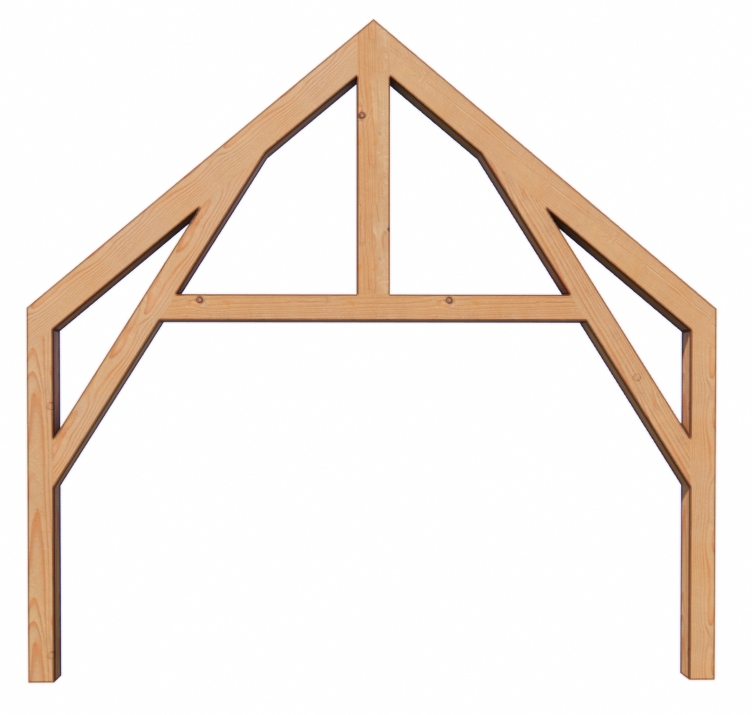
HAMMER BEAM
Hammer beam trusses are as strong as they are beautiful and ornate. This truss type is primarily found in homes and our timber frame pavilion kits with vast open ceilings, as the center area of a hammer beam truss is very large and open. For that same exact reason, many cathedrals make great use of hammer beam trusses in their construction.
The design of the hammer beam truss is slightly more complex than that of the king post or queen post truss. The simpler form of the hammer beam truss is characterized by a small post and collar tie at the top for stability, with two hammer posts and hammer beams on either side connecting to the collar tie for added strength. The hammer beams are further supported by braces that link into wall posts.
More ornate hammer beam trusses may feature extra complex elements such as curved ties or central ribs. When ribs are added, they add an extra dimension, more beauty, and greater stability.

SCISSOR TRUSS
The scissor truss looks basic and simple, but don't let that fool you! These strong, slightly complex trusses are designed primarily for buildings, and help support sloping roofs. Scissor trusses are found in all sorts of settings, but you see them a lot in pavilions because of their open nature. Scissor trusses are named as such because they are comprised of two top and bottom chords each that intersect en route to connecting to the rafters, therefore creating a “scissor” pattern.

JAMBE DE FORCE
“Jambe de Force” translates into English as “leg of strength”, which a jambe de force truss easily demonstrates. The jambe de force truss is used primarily in buildings as well, seen in many cabins, homes, and pavilions with vast open roofs. A jambe de force truss looks almost like a hammer beam truss, but more triangular. You'll find a collar tie and post at the top, which is buttressed by jambe de force braces and central beams that provide a great deal of strength and support.
ARE THERE OTHER TYPES OF TIMBER FRAME TRUSSES?
Yes! Covering these five most common types of trusses only scratches the surface of the truss types used in timber framing. The best way to learn about other timber frame trusses, and to discover which timber frame truss might be best for your project, is to connect with our knowledgeable timber framing pros.
Give us a call at (931) 432-0132 or fill out our online contact form to schedule a chat or a meeting. We look forward to hearing from you!
Somewhere during your research on the ins and outs of building a timber frame home, you've probably come across some fairly unfamiliar terminology. Upon first glance, some of the terms used to describe construction and raising processes can be very confusing. To help you understand some of what's being said to describe parts of the process, we've put together a quick little glossary of timber framing terms.
NOTE: By no means is this a comprehensive listing! The terms and definitions you'll find below are just some of the most commonly-used in the craft. If you'd like a more comprehensive list of timber framing terms and what they mean, please feel free to send us a message or give us a call today.
Commonly-Used Timber Framing Terms & Definitions:
BEAM – Used to describe a horizontal timber standing in a structure.
BENT – Load-bearing structures that are joined on the ground and then raised to comprise the front, center, and back of a traditional timber frame structure.
BRACE – Timber supports that are placed diagonally in the corners of a frame to reinforce the structure.
BUTT – Refers to simple square-cut joints that connect by “butting” up against each other.
CHAMFER – A 45-degree routed edge that primarily serves as a decorative flourish, but can also serve as a safety measure to prevent injury related to coming in contact with sharp timber edges.

DOVETAIL – A decorative but functionally strong joint that fans out in the shape of a dove's tail and locks into a similarly-shaped pocket.
GIRT – Horizontal timbers within and surrounding bents that serve as a frame for upper levels of a timber frame structure.
GREEN – Used to refer to timber that still contains some degree of moisture. Most of the timbers used to construct your frame will be “green” timbers.
GUNSTOCK POST – A vertical support in a bent that allows formations of intersections between beams and other supports.
HAMMER BEAM – A tie beam used in open trusses to provide structural support to walls.

JOIST – Horizontal timber beams that bear the weight of flooring and serve as ceiling supports.
KING POST – A timber that serves as a crucial center point of intersection for other timbers in a truss.
MORTISE – The “male” connective end of a timber.
POST – Used to describe any vertical timber in a frame.
PURLIN – A horizontal reinforcement beam found at the top of a timber bent. These timbers support the roof deck.

QUEEN POST – A vertical timber used as one of two supports in a truss. A queen post can be used in conjunction with or as an alternative to a king post.
RAFTER – A horizontal timber that's used as a roof support.
RECLAIMED – A term used to describe “recycled” timbers gathered from previously-standing structures for use in a timber framing project.
SUMMER BEAM – A beam used as a central weight support in larger open areas.
SPLINE – A thin piece of wood used as a way to reinforce timbers or splice them together.

TENON – The “female” connective end of a timber, cut to match the shape and size of the mortise for structural support.
THROUGH JOINT – A joint in which a tenon passes completely through the mortise.
TREE NAILS – Wooden pegs used to reinforce or hold connection between a mortise and tenon.
If you'd like to learn more about the terminology used for timber framing, feel free to get in touch with us today! We'll be more than happy to assist you in your learning journey.

